Saigon has secret corners. I like this small-group walk because it threads classic downtown sights together with Vietnam War stops most people miss, including the Secret Weapons Cellar and the War Remnants Museum. The one thing to plan for is a small extra entrance cost for those two sites.
You’ll also get the best kind of contrast: Buddhist devotion at the Thích Quảng Đức Memorial and the Jade Emperor Pagoda, then the blunt aftermath of war inside the museum. A big win is that the tour includes time with a local guide in a family setting, not just photo stops on a sidewalk.
If you want an introduction to Ho Chi Minh City that feels more personal than a bus-and-bite itinerary, this is a strong choice. The tour uses a mobile ticket, runs with an English-speaking local expert, and you can request a vegetarian option when you book.
In This Review
- Key things to know before you go
- Why this Ho Chi Minh City walk hits the right balance
- Price and what you really pay for
- Logistics that keep the day easy
- Secret Weapons Cellar: a Saigon bunker you’ll remember
- A family-home stop with your guide (yes, in the living room)
- Thích Quảng Đức Memorial: religion, protest, and shock value in a single moment
- Jade Emperor Pagoda: Vietnamese faith you can see, not just read about
- French colonial buildings you can read like a map
- The French Archbishop’s Palace and Saigon’s older roots
- Lê Quý Đôn High School: early French schooling in Saigon
- War Remnants Museum: powerful, practical, and worth budgeting time for
- Independence Palace: rooms where history ended in 1975
- Who this tour is best for
- Practical tips for getting the most from your guide
- Should you book this Ho Chi Minh City walking tour?
- FAQ
- Is this tour really free?
- How long does the walking tour take?
- How big is the group?
- What’s included, and what costs extra?
- Do I need tickets for the Secret Weapons Cellar and War Remnants Museum?
- Where do I meet the guide, and where do we end?
- Is there a vegetarian option?
Key things to know before you go
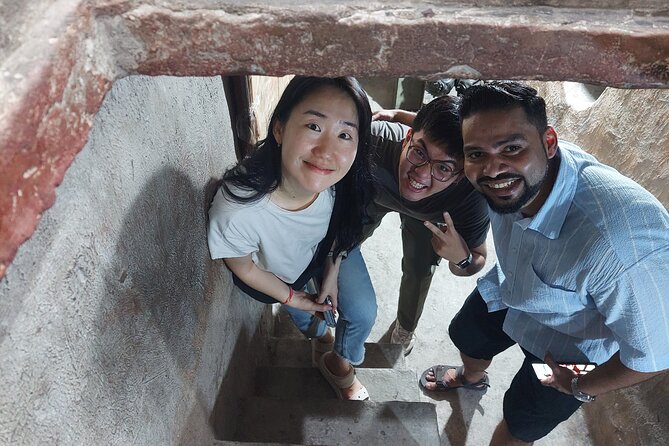
- Small-group feel: designed for an intimate pace (capped at eight travelers).
- A mix of Saigon and war: colonial landmarks, religion, and Vietnam War history in one 2–3 hour loop.
- The Secret Weapons Cellar stop: a Vietnam-era bunker that’s easy to overlook on your own.
- A family-home interlude: you’ll meet your guide in a home setting and hear stories over coffee.
- Respectful memorials: the Thích Quảng Đức Memorial is a powerful moment, not a quick photo.
- Budget a little extra: the Weapon Bunker and War Remnants Museum have a $2 per person admission fee.
Why this Ho Chi Minh City walk hits the right balance
Ho Chi Minh City can feel like two cities at once. There’s the postcard part: grand French-era buildings, wide streets, and lively neighborhoods. Then there’s the part that explains why the city looks the way it does now, including the Vietnam War’s long shadow.
This tour’s strength is the way it holds those themes side by side without turning either one into a lecture. In a short 2 to 3 hours, you’ll get oriented around downtown landmarks and then shift into sites tied to war and faith. That structure matters, because it prevents you from sightseeing in a fog of names and dates.
You can also read our reviews of more walking tours in Ho Chi Minh City



Price and what you really pay for
The headline promise is $0, but the reality is simple: it’s a tips-only walking tour. Your base cost is effectively what you choose to tip the guide, and that’s part of the value equation.
Why that can be a good deal:
- You’re paying for guide time and interpretation, not just access to a building.
- The group is small, so your questions actually land.
- You’re getting local context at multiple stops, including one inside a family home.
The one non-negotiable cost to plan for is admission for the Weapon Bunker and the War Remnants Museum. Those are priced at $2 per person. Everything else on the route is free to visit. In other words, you’re not paying a stack of entry fees just to get the main story.
Logistics that keep the day easy
You start at a 7-Eleven on Tôn Thất Tùng in District 1 (23 Tôn Thất Tùng, Phường Phạm Ngũ Lão, Quận 1). The tour ends near the Independence Palace area and Ben Thanh (District 1). That matters because you finish in one of the most convenient pockets of central Saigon, where it’s easy to grab food or hop on a ride afterward.
The tour is a walking experience, so wear shoes you can move in comfortably. Saigon weather can be warm and humid, and this route doesn’t pretend you’ll sit down all day. The good news: the total time is short enough that you can pace yourself and still keep the rest of your afternoon free.
Secret Weapons Cellar: a Saigon bunker you’ll remember

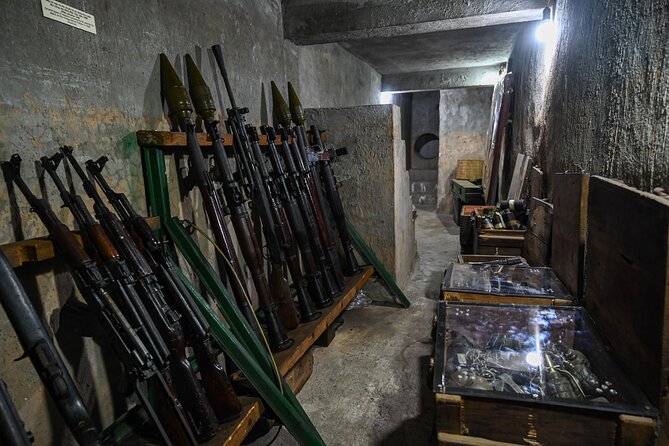
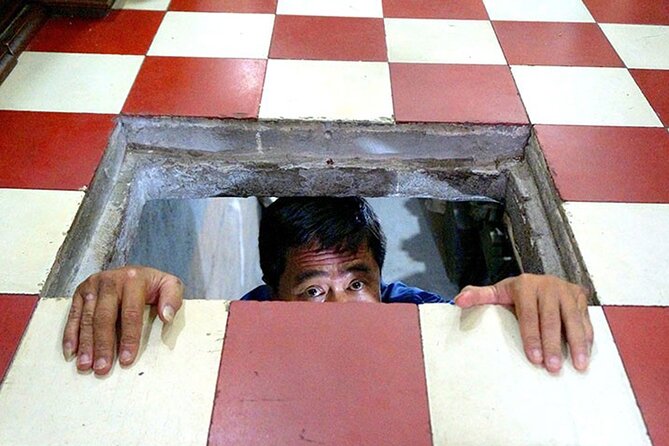
One of the most compelling stops is the Saigon Secret Weapons Bunker, also described as a Secret Weapons Cellar. This is a Vietnam War relic that many visitors miss because it isn’t as famous as the big-name landmarks.
On the ground, what makes it effective is how physically real it feels. A bunker can’t be explained away like a photo exhibit. You walk through the space and the story becomes grounded: ingenuity, logistics, and the fact that war reshaped everyday lives.
Time-wise, the stop is about 20 minutes. That’s long enough to understand the basics and take it in, without dragging out to the point where it becomes tiring.
Entrance note: you’ll pay the $2 per person admission fee for the bunker.
A family-home stop with your guide (yes, in the living room)
Another reason this tour works is the unusual stop with your guide’s family. You’ll step off the public sidewalk and into a home setting where history shows up in photos and in stories, shared over coffee.
This part isn’t just for atmosphere. It gives you a human scale for the war and for the city’s changes since then. Instead of hearing history as a timeline, you hear it as lived experience—what people remember, what they think is important, and how they talk about the city now.
One practical detail: in a real-world example of what “local” can mean, the guide Joseph went beyond the standard script by arranging transfers from a cruise port and even lending visitors money so they could buy an iced coconut coffee when they hadn’t brought local dong. That’s not something you should assume will happen every time, but it does show the kind of helpful, hands-on attitude this tour can have.
You can also read our reviews of more city tours in Ho Chi Minh City

Thích Quảng Đức Memorial: religion, protest, and shock value in a single moment
At the Thích Quảng Đức Memorial, you’ll learn about the Buddhist monk who self-immolated in protest during the Vietnam War. This stop is described as moving, and that’s accurate: it’s a moment where the war story intersects with faith and moral action.
What you’ll likely appreciate here is the way the tour doesn’t treat the memorial like a landmark you zip past. It sets it up as a key historical signpost—one that helps you understand why religion wasn’t separate from politics during the conflict.
Time is around 20 minutes, which is about right. You need enough time to take it seriously, but not so much that it turns into a classroom.
After this, the route shifts from protest to religious practice with a visit to the Jade Emperor Pagoda (you’ll see Vietnamese religion up close as part of the tour).
Jade Emperor Pagoda: Vietnamese faith you can see, not just read about
The Jade Emperor Pagoda is part of the tour’s promise, and it’s a smart inclusion. Downtown Saigon can be all architecture and institutions. This temple stop adds spiritual texture, so the trip isn’t only political history.
Even without a long lecture, a temple visit changes how you look at the city. You notice details people walk past elsewhere: how space is used for worship, how ceremonies shape the mood of a place, and how belief shows up in daily life.
This stop also helps you reset emotionally after the war-focused sites. It’s a reminder that history didn’t just happen “to” Vietnam; it’s also something people live inside every day.
French colonial buildings you can read like a map
The walk includes major markers of Saigon’s colonial and post-colonial identity. You’ll see the types of buildings that give downtown its signature look, including exteriors tied to the Saigon Opera House, People’s Committee Building, Central Post Office, and Saigon Notre-Dame Basilica. Expect the guide to point out what those buildings represent in different eras.
Two specific stops connect directly to that story:
The French Archbishop’s Palace and Saigon’s older roots
You’ll visit Tòa Tổng Giám Mục Sài Gòn, located in the French Archbishop’s Palace. It’s described as Saigon’s oldest building, and the chapel detail is a great hook: the tiled chapel was built for Lord Nguyen Anh in 1790, 12 years before he became Emperor Gia Long.
This isn’t just trivia. Hearing that timeline helps you see how layers of power shaped the built environment. A structure that survived multiple eras becomes a physical record of shifting influence.
The stop is shorter—around 10 minutes—but it’s the kind of short visit where the story changes the way you look at the façade.
Lê Quý Đôn High School: early French schooling in Saigon
Next is Lê Quý Don High School, described as the first French colonial school in Saigon. It’s included to show the “education as influence” angle of colonial contact: schools aren’t neutral. They teach language, systems, and values, and the building itself becomes part of that historical message.
The time here is about 10 minutes, again enough for orientation and explanation without turning the walk into a long series of classrooms.
War Remnants Museum: powerful, practical, and worth budgeting time for
The War Remnants Museum is the tour’s second heavy-hitter. Expect about an hour here, and expect to feel it. The museum presents the impact of the Vietnam War through exhibits, photographs, and military artifacts, with an emphasis on how the war’s effects linger.
Here’s how to get the most out of it:
- Move at your own pace and don’t try to see everything at once.
- Pick a few exhibit sections and give them attention instead of sprinting.
- If you’re sensitive to graphic imagery, take breaks early rather than pushing through.
Entrance note: the War Remnants Museum has a $2 per person admission fee.
The hour window is useful because it gives you time to absorb without turning your entire day into museum fatigue.
Independence Palace: rooms where history ended in 1975
The route finishes with the Independence Palace (also called the Reunification Palace). This is the site where the Vietnam War ended in 1975. It’s also where the presidential home and command center once operated.
What makes this stop meaningful is how history is stored in spaces: preserved rooms, a rooftop helipad, and areas that help you visualize decision-making rather than just reading about it. It’s the kind of visit where you start thinking in terms of timing and command, not only battles.
This stop is relatively short (about 10 minutes on the walk). That can work well if you’re using it as a finish line and planning a longer revisit later.
Entrance note: the Independence Palace admission is listed as not included, so you should be ready to pay if you want to go inside and explore more fully.
Who this tour is best for
This is a great fit if you:
- Want a focused, first-time introduction to Ho Chi Minh City downtown
- Like tours that connect history to places you can stand in
- Prefer small groups over big crowded walks
- Want both Vietnam War context and religious sites like the Jade Emperor Pagoda
It may be less ideal if you:
- Can’t handle emotional content tied to war and protest
- Want a route with zero museums (this has two major war-related stops)
Practical tips for getting the most from your guide
A few things that will make your experience smoother:
- Bring some cash for the two paid sites (Weapon Bunker and War Remnants Museum cost $2 per person). Local dong is useful, but the tour info doesn’t spell out currency handling, so having backup cash helps.
- Wear comfy shoes. You’ll walk most of the day, just not all day.
- If you have dietary needs, request the vegetarian option when you book.
- Ask questions. The tour includes a conversation-heavy family-home stop, and that’s where you’ll get the most useful answers.
Should you book this Ho Chi Minh City walking tour?
If your goal is an efficient, human-scale introduction to Saigon that mixes architecture, Vietnamese religion, and Vietnam War history, I’d book it. The small group design (capped at eight) makes a difference, and the inclusion of the Secret Weapons Cellar plus the War Remnants Museum means you aren’t stuck with only textbook versions of history.
The decision hinges on one practical point: you should be ready for the $2 per person admission fees at two stops, plus possible additional entry costs at Independence Palace. If that extra spending won’t bother you, this is excellent value for the interpretation and the range of sites.
FAQ
Is this tour really free?
It’s run on a tips-only basis, so the basic idea is that you choose what to tip rather than paying a fixed tour price.
How long does the walking tour take?
Plan on about 2 to 3 hours.
How big is the group?
The experience is capped at just eight travelers for the intimate guided feel. The activity listing also notes a maximum of 20 travelers.
What’s included, and what costs extra?
A local English-speaking expert guide is included, and the tour runs on a tips-only basis. You’ll pay entrance for the Weapon Bunker and the War Remnants Museum at $2 per person.
Do I need tickets for the Secret Weapons Cellar and War Remnants Museum?
You’ll budget $2 per person for admission for those two stops.
Where do I meet the guide, and where do we end?
You meet at 7-Eleven at 23 Tôn Thất Tùng, Phường Phạm Ngũ Lão, Quận 1. The tour ends at the Independence Palace area near Ben Thanh in District 1.
Is there a vegetarian option?
Yes. A vegetarian option is available, and you should advise when booking.